
By the third year of running a restaurant chain in Pune, four IIT Bombay graduates had settled on a way of deciding who was in charge. They took turns.
All four had studied the same subject. All four had put in the same money. None would accept that one of the others should lead, so they rotated the chief executive’s job between them. Their mentors told them this was foolish. They carried on anyway.
“Obviously we were fools. We were children doing very childish things, and clearly fools to run that business.”
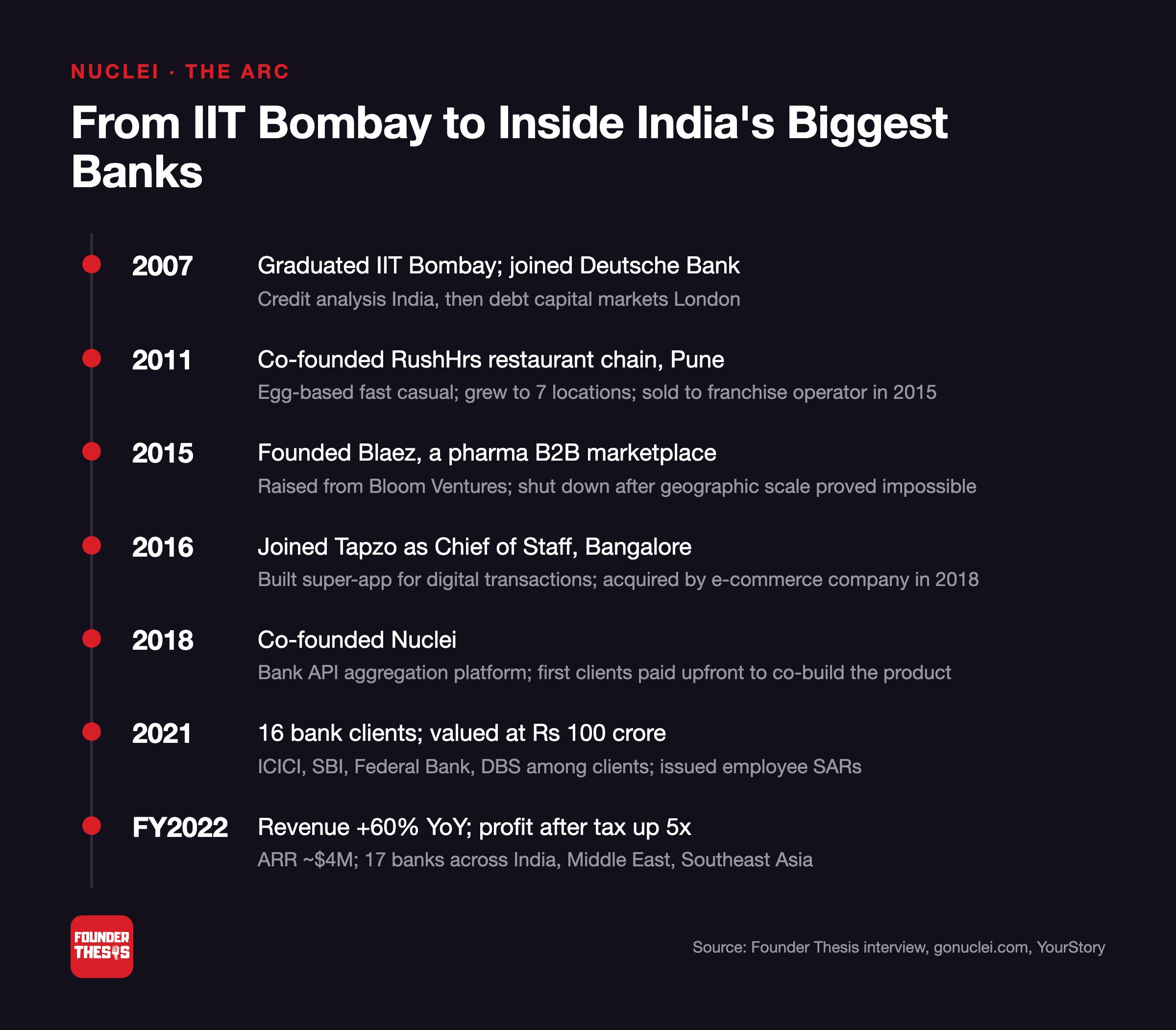
That is Ankur Joshi, describing himself, unprompted, on the Founder Thesis podcast. He now runs Nuclei, a bootstrapped software company whose product sits inside the mobile apps of ICICI Bank, State Bank of India, Federal Bank and DBS. He reached it by failing three times, and then doing something unusual with the wreckage.
Listen to this episode on Apple Podcasts · Amazon Music
The dream was smaller than you would expect
Before any of this, when Joshi was in class twelve in Indore, a man from Bombay rented the ground floor of his family’s house. The tenant spoke confident English and played Bryan Adams records. To a teenager upstairs, that was the whole of ambition: leave your city, live on your own money, be that self-contained.
He costed it out. Two and a half to three lakh rupees a year, of which he would save ten thousand. That was the plan.
He got into Deutsche Bank almost by accident. The bank ran an entrance exam modelled on the CAT, which let in a few candidates whose grades sat below the cut-off but who tested well. Joshi was one. His first interview was taken by someone he had played inter-IIT football against, and by his own account both interviews were spent talking about football and about Indore. He spent his first year on credit analysis for the Indian market, then moved to London selling corporate debt across the Nordics and Benelux.
He left in 2011. The reason he gave at the time was job satisfaction. The reason he gives now is sharper: every decision that shaped his day was being made by somebody else.
Why four co-founders with identical skills is a trap
The restaurant was called RushHrs, and it was built around eggs, because all four of them liked eggs. Chicken and mutton came later. It was fast-casual, small footprints, delivery-led. Within two years they were substantial enough to raise loans from a cooperative bank, which paid for four more outlets. By the third year they were profitably running seven locations on roughly 18% margins.
It was, on paper, working. It was also going nowhere.
When I put it to him that he might be blaming the sector unfairly, given that Rebel Foods and Wow! Momo had scaled national chains out of the same market, he did not take the escape route.
“It’s not true for everyone, but it was true for us. If I have to be honest, I personally failed at multiple levels. I did not think big. If I have to summarise, I was a fool then. If you have to rate me from a business planning perspective, I would not rate myself even one out of ten. I was so poor back then.”
The specific failure he keeps returning to is not strategy. It is composition. Four people with the same degree and the same instincts had divided up the skills none of them had and forced each other to learn them. There was nobody in the room who thought differently.
Underneath that sat something harder to admit. They were friends, and so they were careful with each other. Asked how a founder is supposed to keep friendship and business apart, Joshi gave a test rather than a rule.
“If you are thinking twice before giving an honest feedback to your co-founder, then the relationship is not great. We were afraid of confronting each other because we were thinking about the other’s feelings rather than about the business.”
By the third year the money had stopped being abstract. They were married by then, several of them, living month to month on a fraction of what they had earned in banking. In 2015 they sold RushHrs to one of their own franchisees, who still runs it.
How do you know when to shut a startup down?
His next venture, Blaez, was a marketplace connecting pharmaceutical distributors to retailers. He raised from Bloom Ventures after pitching around twenty firms and collecting two term sheets, a process that had him shuttling between Pune and Bombay twice a week for months. The door opened through a college junior who was then at Bloom.
Then he took the platform outside Pune and found that pharma distribution barely resembled itself from one city to the next. Distributors held city-level monopolies. The ERP systems differed. The thing that worked in Pune could not simply be carried to Delhi.
What happened next is the first evidence that the restaurant had taught him something. He did not spend two years hoping. He shut Blaez down, returned the investors’ money, and left.
“One thing which I particularly learned in RushHrs was that if things are not working out, just move on very, very fast. Don’t linger on. In hindsight I probably spent two years extra in the restaurant business.”
In 2016 he moved to Bangalore, on the reasoning that a technology business could not be staffed in Pune, and joined Tapzo, then building an all-in-one consumer app. He did everything there except write code. It was acquired in 2018.
The six guardrails Ankur Joshi wrote after three failures
Most founders say they learn from their mistakes. Joshi noticed that he did not.
So after Tapzo, with time on his hands, he sat down and wrote out every mistake he had made across all three ventures. The list stopped being a memoir and became a set of operating constraints, kept visible, applied to every decision about what to build next. These are the guardrails he described, each one traceable to something that had already cost him.
Think global from day one. Both previous businesses died at a city boundary. The restaurant never left Pune; the pharma platform broke the moment it tried to. Whatever came next had to work in a form that did not depend on one geography’s plumbing.
Build something sustainable, not something to flip. An eight-to-ten year business rather than an exit dressed up as a company, funded out of revenue instead of investment, because funding it any other way makes the unit economics somebody else’s problem to discover.
Be profitable as early as possible. He had already run a profitable business and found it insufficient; he had also seen Tapzo’s category struggle to explain how it would ever make money. He wanted the harder half first.
Stay lean, especially when things are going well. His emphasis was on the second half. Frugality under pressure is easy. Frugality with money in the bank is the discipline that actually has to be designed.
Think long term about people, clients and products alike. Including which customers you take. A client relationship that is unpleasant will still be unpleasant in year six, and you will have signed up for it voluntarily.
Reduce emotional stress as a deliberate goal. This is the one he came back to most insistently, and the one least likely to appear in anybody else’s list of principles.
“If I look back, the one thing I would change is the amount of emotional stress I took whenever things were not great. Optimise not for money or for freedom, but for mind space. The moment you have enough mind space, that is essentially luxury.”
He applied the same retrospective honesty to co-founders. This time the criteria were the inverse of what had sunk RushHrs: complementary skills rather than matching ones, and an explicit agreement that disagreements get confronted rather than nursed. His current co-founder runs technology; Joshi runs everything else.
How Nuclei got its customers to fund the product
Working from those constraints, Joshi ruled out consumer businesses and went looking for a B2B problem. He looked at telecoms, banking and insurance, dropped telecoms because they could not pay upfront, and judged banking to be a couple of years ahead of insurance on digital adoption.
Then he did something slower than it sounds. He and his co-founder met around a hundred banks across India, the Middle East and Southeast Asia, and asked each of them what was broken. The product accumulated across those conversations. When the same complaint surfaced for the fifth time in twenty meetings, it became something worth pitching to the next six bankers.
The complaint that kept recurring was integration. Banks want to build core banking themselves and want nothing to do with wiring up a flight booking engine, a mobile recharge provider or a healthcare partner. Each of those is slow, and none of it is their craft. Nuclei aggregates the integrations, drops the platform into the bank’s existing app, and absorbs the vendor onboarding, reconciliation and settlement. The bank reconciles with one counterparty instead of thirty. Revenue comes from an annual licence fee plus a share of the transaction commission. If you book a flight inside the ICICI mobile app, that is Nuclei underneath.
The financing followed from the method. Three or four of those banks co-built the first version and paid upfront to do it, which is how a company with no venture capital funded its own product. It is the same trick Decentro pulled in API plumbing for fintechs, arrived at from a different direction, and the opposite of the path Vinod Murali’s Alteria Capital exists to finance.
“We wanted to build a sustainable business. We were also not sure whether this would work, so we did not want to waste anyone’s money.”
How do you sell to a bank when nobody has heard of you?
Enterprise banking sales in India runs six to nine months with the paperwork. Nuclei’s fastest close was five or six weeks. Its longest ran eighteen months, at a company that had only existed for twenty-two.
I asked him whether there was a hack. There was not, but there was a phrase.
“Micro courage. Not in a macho sense. The courage to make that call every day. A lot of people are scared of cold calling because they are afraid the other person’s ego will be hurt. If you are starting your own company, you just cannot afford to have an ego.”
In practice this meant reaching bankers in Indonesia and the Middle East, where he knew nobody, through LinkedIn, Twitter and guessed email addresses, and accepting a conversion rate of roughly one meeting per ten attempts. It also meant being shouted at. People demanded to know where he had got their number. When that happened, somebody else from the company would call the secretary, or send an email, and find another way in.
The reframe underneath it is worth borrowing: most opportunities are lost not to rejection but to the anticipation of it. A good share of Nuclei’s client list exists because someone was willing to ask and be told no. That willingness to keep pitching until one lands is the same muscle Stack Finance leaned on building wealth tools for a new generation of investors.
What Ankur Joshi looks for when hiring salespeople
Courage is the entry ticket. What he actually screens for is stranger.
He wants people who can tell a story, and who can hold a conversation across history, geopolitics, philosophy, books. The reasoning is unsentimental. Organisations do not buy from organisations; a person buys from a person, and a narrow person cannot build the relationship that makes that possible.
He does not run interviews. He has conversations, on the premise that anyone he hires should plausibly still be there in five years, and you cannot assess five years from static answers to static questions. He asks what people care about outside work. He tells them his own story, and expects theirs in return. He once told a candidate interviewing from home in a suit to appreciate the seriousness and then lose the jacket.
Where Nuclei is now
At the time of this conversation Nuclei was live in around sixteen banks, mostly Indian, with DBS and one bank in the UAE representing the beginnings of the global ambition. Joshi wanted thirty-five by the end of 2021 and fifty-odd within a few years. He tracked cash flow rather than the profit and loss, on the view that a business with cash keeps its options and the rest can be solved later.
The company has since issued stock appreciation rights to employees, and continues to run without institutional funding.
The most revealing thing he said came at the end, when I asked what was next. After a detour about whether he and his wife could manage a third dog alongside Hazel and Rasna, he answered the professional half of the question in a way that would sound like false modesty from most founders, and does not from a man who has already written down every mistake he ever made.
“I’m sure after five or ten years there will be someone better suited to run Nuclei than me. I just have to be honest enough with myself to understand that, and hand it over.”
Sources
Nuclei Annual Letter 2022, gonuclei.com
Nuclei issues stock appreciation rights for employees, YourStory
Serial entrepreneur Ankur Joshi on building a bootstrapped SaaS company, SaaSBoomi
The First Thing We Build Is the Team, India GameChanger
Nuclei company profile, Tracxn
Nuclei company profile, YourStory