

Dale Vaz quit as Swiggy’s CTO to start a stock broker in a market that already looked finished. India’s discount brokers have won the access war. Opening a demat account takes minutes, a trade costs ₹20 or less, and the leaders print money. Zerodha reported ₹8,868 crore in revenue and ₹4,237 crore in profit for FY25. Groww’s market cap crossed ₹1 lakh crore within four trading sessions of its November 2025 listing.
So when I sat down with him, I asked the obvious question. Why would anyone launch a new broker in 2025?
Dale Vaz is the co-founder and CEO of Sahi, a Bengaluru discount broker that charges a flat ₹10 per order and was valued at $200 million in its $33 million Series B in April 2026, about 16 months after launch. His answer convinced me that the next fortune in Indian broking will go to whoever helps traders make better decisions. Tapping buy is already solved.
Check out the video of the conversation here or read on for insights.
Dale Vaz: from Amazon and Swiggy to Sahi
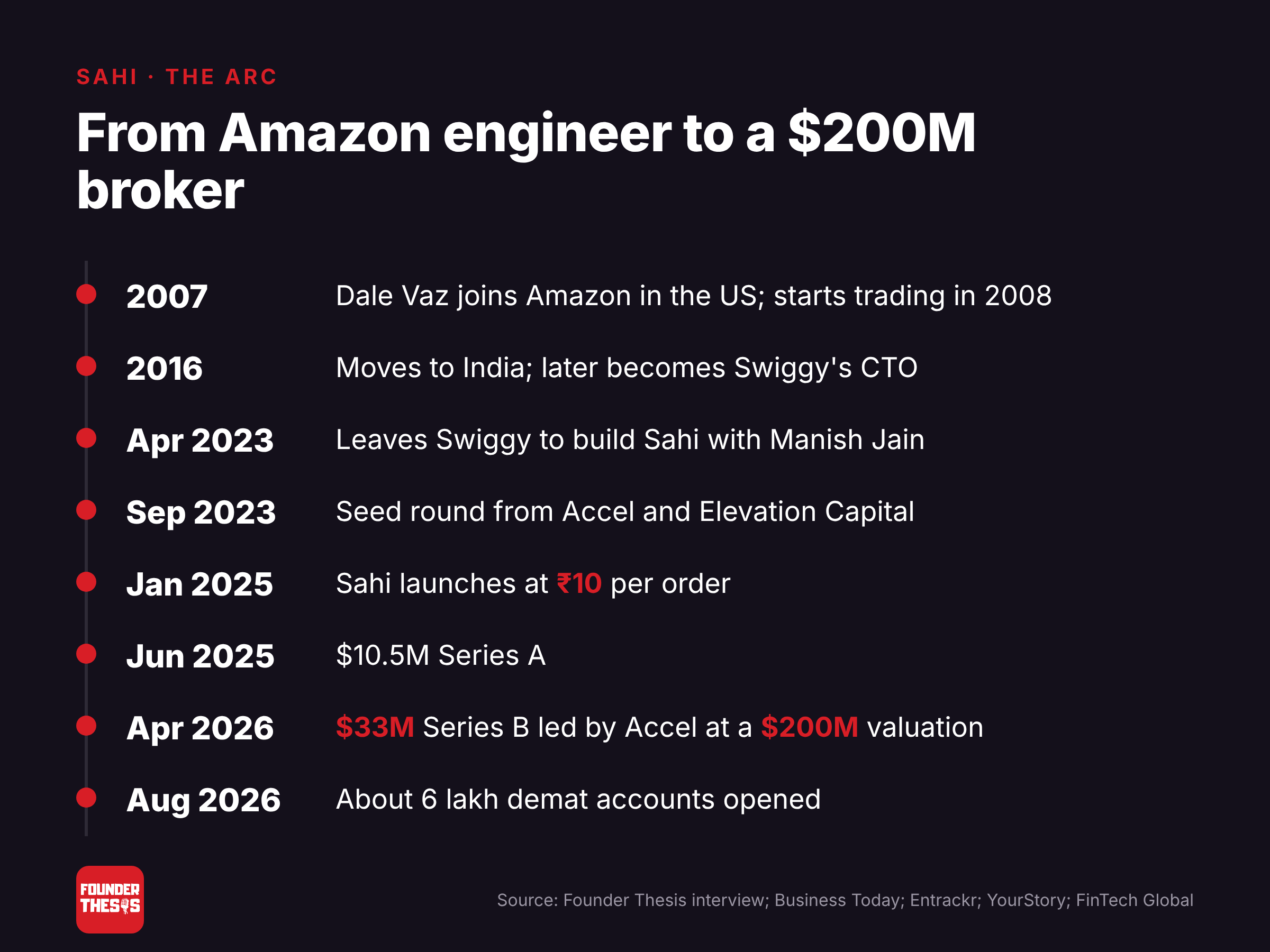
Dale Vaz has spent his career building consumer technology, and nearly two decades trading on the side. He joined Amazon in the US in 2007, when it was still fighting Toys “R” Us, Best Buy and Circuit City. He started trading in 2008, moved to India in 2016, and kept trading through his years at Amazon India and then Swiggy, where he became CTO.
He left Swiggy in April 2023, while the company was preparing for its IPO, and co-founded Sahi with Manish Jain, a former vice president at Kotak Securities who is Sahi’s chief product officer. Accel and Elevation Capital wrote the seed cheque in September 2023, about ₹56 crore according to Entrackr’s reading of the filings. Sahi went live in January 2025.
Dale doesn’t dress up the trading part of his life. He told me there were days when his losses were so big he didn’t get out of bed. That history shows up all over the product.
What actually happens when you tap buy
Dale walked me through a trade, and it explains why a newcomer can compete with Zerodha at all. When you add money, it moves into a broker account held in your name. When you buy ₹1 lakh of Swiggy shares, the order goes to NSE or BSE, which is an order-matching engine that finds a seller. A large order gets split into several trades with several sellers. The seller sees the money the next business day, because India settles on T+1.
Your shares never sit with your broker. They sit with a depository, NSDL or CDSL, tied to your PAN. Dale calls it a bank for your stocks. Sahi works with CDSL. If a broker shuts down, your holdings are still there, and you can move them between brokers through CDSL’s Easiest portal.
Your cash is protected the same way. Brokers used to park client money in a pool account and earn interest on it. Now every broker has to sweep unused client money to the clearing house at the end of each day.
So SEBI has made the plumbing safe and identical for everyone. The only place left to compete is the product the trader touches.
How Sahi makes money at ₹10 a trade
Sahi’s business model is simple: it earns ₹10 every time a customer places an order, whether that’s a stock purchase, an intraday trade or an options trade. Most discount brokers charge ₹20, and new users get their first 30 days free. Dale wouldn’t share revenue, but he confirmed that 100% of it comes from that transaction fee today.
Halving the market price is a lesson Dale took from Jeff Bezos.
“It needs to be so good that somebody has to be financially irresponsible to not choose Amazon.”
It’s the D-Mart logic applied to broking: run cheaper than everyone else and hand the saving to the customer. Sahi built its entire broking stack with fewer than 10 engineers and runs today with about 80 people across operations, support, product, growth and tech. Dale’s plan is to use AI to automate internal work so the price can stay at ₹10.
The next revenue lines are the ones mature brokers already run. Margin funding lets a trader borrow against the shares they buy, at the 14% to 15% annual interest Dale says is the industry rate. Loans against shares and mutual funds come through NBFC partners, with the broker earning a trail on the interest. Sahi is entering a field I’ve covered before: Raghu Kumar walked me through building Upstox, and Tajinder Virk’s Finvasia took the price war all the way to zero brokerage with Shoonya.
For buy-and-hold investors, Dale’s advice is plain: low-cost ETFs that track an index, the approach Sanjay Arya laid out in our Morningstar masterclass on indexes. Sahi offers ETFs but not mutual funds yet.
Why 93% of F&O traders lose money
The trader Sahi was built for is the active one, and the numbers on that trader are brutal. A SEBI study released in September 2024 found that 93% of individual traders in equity futures and options lost money between FY22 and FY24, with aggregate losses above ₹1.8 lakh crore.
Dale explained options with a pizza. You pay a shop ₹10 for a coupon that lets you buy a ₹200 pizza at ₹200 for the next month. If the price goes to ₹220, your coupon is worth ₹20 and you’ve doubled your money on a 10% move. That’s the attraction. If the price doesn’t move, the coupon expires and the ₹10 is gone. Option sellers price these coupons so the buyer usually loses, and the move you’re betting on is often already in the price. As I put it to him, you’re buying a ticking clock.
Dale still refuses the easy label.
“I don’t subscribe to the view that traders are gamblers. I believe that most people here are trying to somehow figure out how to improve their life.”
His fix is discipline, and he’s specific about it. Size each position small, starting with a probe trade before adding. Decide your exit, for both profit and loss, before you enter. And set a daily maximum loss and profit, then close the laptop when you hit either one.
The kill switch: a broker that tells you to stop
Sahi built that third rule into the app. A feature called P&L Protect lets a trader set a daily maximum loss and profit. When the account hits either number, Sahi closes the positions. A kill switch can also lock the trader out for the rest of the day.
Then there’s the nudge. If a trader’s losses run well above their recent average, Sahi’s AI agent sends a message suggesting a pause, with a button to turn on the kill switch.
“We’re probably one of the first brokers to literally tell the user, stop trading.”
A broker that earns ₹10 per order is telling customers to place fewer orders. Dale’s bet is that traders who survive stay longer, and he says Sahi’s retention and usage beat the market average on the benchmarks he’s seen.
Cairo, Sahi’s AI trading agent
That agent is called Cairo, and in August it was live as a closed pilot for about 15,000 users. Dale compares it to a Formula 1 race engineer: it watches the data and talks in the driver’s ear, and the driver still decides when to brake.
Cairo has a written constitution, and one rule is that it never gives buy or sell recommendations. Ask it whether to buy Reliance and it asks for your reasoning, then pulls in the latest news and quarterly results. It can study your past trades, find the hour when you overtrade, and shade that window red on your chart. It can also place an order from inside the chat, but only after you tap to confirm.
I pushed Dale on whether people will skip broker apps and run everything through a general chatbot. His view is that a general model can sound very intelligent and still never tell you when it’s wrong, and it carries none of a regulated broker’s duty to the customer. He told me Sahi was preparing to release its own MCP connector anyway, so traders can plug it into those tools.
Cairo sits on Sahi’s earlier bet. Most Indian brokers embed TradingView’s charts inside their apps, which Dale found slow on phones and built for desktop. Sahi wrote its own charting engine, Sahi Charts, so a trader can read the chart, place the order and manage the position on one screen.
“With Sahi, we disrupted the market by building our own charts... but frankly, with Cairo, we may be disrupting ourselves.”
Sahi’s growth and funding so far
When we recorded in August 2026, Sahi had onboarded about 6 lakh demat accounts in roughly 18 months. Dale said it had ranked in the top three brokers for new account additions for about six months, behind Groww, and had about 2.5 lakh active traders, which put it at number 18 among all Indian brokers by active clients.
The funding has kept pace. After the 2023 seed, Accel and Elevation Capital put in a $10.5 million Series A in June 2025. In April 2026 Accel led the $33 million Series B, with about $20 million of it, alongside Elevation, at a $200 million valuation. By then Sahi had processed 130 million trades.
Sahi is owned by its two co-founders, Dale Vaz and Manish Jain, along with an employee stock pool and its investors, led by Accel and Elevation Capital.
My take
Dale’s argument comes down to one line he gave me.
“What we have solved over the last 10 years is access to the market. But we really haven’t given people the confidence and the clarity they need to be able to make informed decisions about their money.”
I agree with him. Zerodha and Groww proved how big this market is. The open question is who helps the 93% lose less, and Sahi is the first broker I’ve seen build its product around that question. The test comes when margin funding launches, and a broker that earns interest on leverage has to keep telling its users to stop.
Listen now!
Other ways to listen:
Sources
SEBI, “Updated SEBI study reveals 93% of individual traders incurred losses in equity F&O between FY22 and FY24”, 23 September 2024: https://www.sebi.gov.in/media-and-notifications/press-releases/sep-2024/updated-sebi-study-reveals-93-of-individual-traders-incurred-losses-in-equity-fando-between-fy22-and-fy24-aggregate-losses-exceed-1-8-lakh-crores-over-three-years_86906.html
FinTech Global, “Sahi raises $33m Series B at $200m valuation”, 30 April 2026: https://fintech.global/2026/04/30/sahi-raises-33m-series-b-at-200m-valuation/
YourStory, “Broking platform Sahi raises $33M in Series B led by Accel”, April 2026: https://yourstory.com/2026/04/funding-broking-platform-sahi-33-million-series-b-accel
Entrackr, “Decoding seed round of former Swiggy CTO Dale Vaz’s startup”, 22 January 2024: https://entrackr.com/2024/01/decoding-seed-round-of-former-swiggy-cto-dale-vazs-startup/
Outlook Business, “Former Swiggy CTO Dale Vaz, ex-Kotak VP Manish Jain launch mobile trading platform Sahi”, 10 December 2024: https://www.outlookbusiness.com/news/former-swiggy-cto-dale-vaz-ex-kotak-vp-manish-jain-launches-mobile-trading-platform-sahi
Business Today, “Swiggy CTO Dale Vaz resigns, Madhusudhan Rao to replace him”, 3 April 2023: https://www.businesstoday.in/latest/corporate/story/swiggy-cto-dale-vaz-resigns-madhusudhan-rao-to-replace-him-report-375848-2023-04-03
Indian Startup News, “Zerodha fails to cross Rs 10,000 crore revenue mark in FY25”, 22 November 2025: https://indianstartupnews.com/news/zerodha-fails-to-cross-rs-10000-crore-revenue-mark-in-fy25-net-profit-falls-23-to-rs-4237-crore-10802936
Outlook Business, “Groww CEO Lalit Keshre joins India’s billionaire club after blockbuster IPO debut”, 17 November 2025: https://www.outlookbusiness.com/start-up/news/groww-ceo-lalit-keshre-joins-indias-billionaire-club-after-blockbuster-ipo-debut