

In the early 2010s, Ezhilarasan Natarajan was inside Microsoft’s partner ecosystem, helping build out Azure, just as the big software sellers were trading licence keys for cloud services billed by the hour. Customers wanted in. They kept getting stuck.
Ezhilarasan “Ez” Natarajan is the founder and CEO of CoreStack, a Bellevue, Washington company with its engineering centre in Chennai, which governs how large enterprises spend on, secure and run their cloud and AI workloads. CoreStack governs more than $6 billion a year in cloud consumption, and Natarajan says it is closing in on $100 million in annual recurring revenue.
Getting there took three or four years with almost no outside money.
Check out the video of the conversation here or read on for insights.
Who is Ezhilarasan Natarajan, the founder of CoreStack?
Natarajan graduated from the University of Madras in 1998 with a gold medal in computer science. He was among the first 50 employees at Alcatel-Lucent’s R&D centre, led integration at i2 Technologies after its $9.2 billion acquisition of Aspect Development, and joined Texas Instruments in Bangalore in 2003.
From 2010 to 2012 he moved to Seattle to lead Mindtree’s Microsoft partnership as Azure grew, then ran Azure and Office 365 cloud services for the China region. In 2015 he started CoreStack with co-founders Thiruvalluvar NB, Sabapathy Arumugam and KK Narayanan. Like Contentstack, it’s an Indian-founded software company selling to global enterprises.
What problem did Ez Natarajan see in the move to cloud?
As Natarajan recalls it, around the mid-2010s the biggest vendors announced they would stop building installable software and offer everything as a service. Customers had to move, and moving was hard.
The CFO faced bills that rose and fell with usage. The CIO found that on-premise workflows broke in the cloud. The security chief had new exposures to worry about. System integrators answered by “throwing human labor” at the problem, as Natarajan put it. Having lived through mainframes, AS/400 and client-server, he was convinced software could do that work instead.
CoreStack started by easing cloud adoption, then followed customers’ next worries: security, then the bill.
What does CoreStack actually do?
CoreStack connects to a customer’s cloud accounts, discovers every workload across AWS, Azure, Google Cloud and Oracle, scores the setup against the providers’ own best-practice frameworks, and fixes what it’s allowed to. A common setup lets it act automatically in test environments, while production changes wait for human approval.
It sells three product lines:
FinOps for the CFO’s team: cost visibility, allocation and automated savings
Security and compliance (Graphion): standards like HIPAA, PCI and FedRAMP, plus each company’s own access rules
CloudOps: provisioning, orchestration and fixing configuration drift
Customers typically spend at least a few million dollars a year on cloud. Below that, Natarajan said:
“Probably one engineer can sit and manage all of it without any complexity.”
His largest customer spends about $1 billion a year. Where platforms like SuperOps.ai manage devices and tickets, CoreStack works on the cloud estate itself.
Why would Amazon and Microsoft help a company that cuts cloud bills?
CoreStack holds partner status with AWS, Microsoft Azure, Google Cloud and Oracle, even though it cuts their customers’ bills.
Natarajan’s reasoning: suspected waste leads to a frozen cloud budget, which hurts the provider far more than a trimmed bill. A customer who trusts its spending keeps adding workloads.
“So we make customers consume more cloud.”
How did CoreStack get funded after years of bootstrapping?
In 2015, few enterprises thought they’d need multi-cloud governance. In Natarajan’s telling, investors saw it as a problem “worth not solving,” and it took three or four years for the market to catch up.
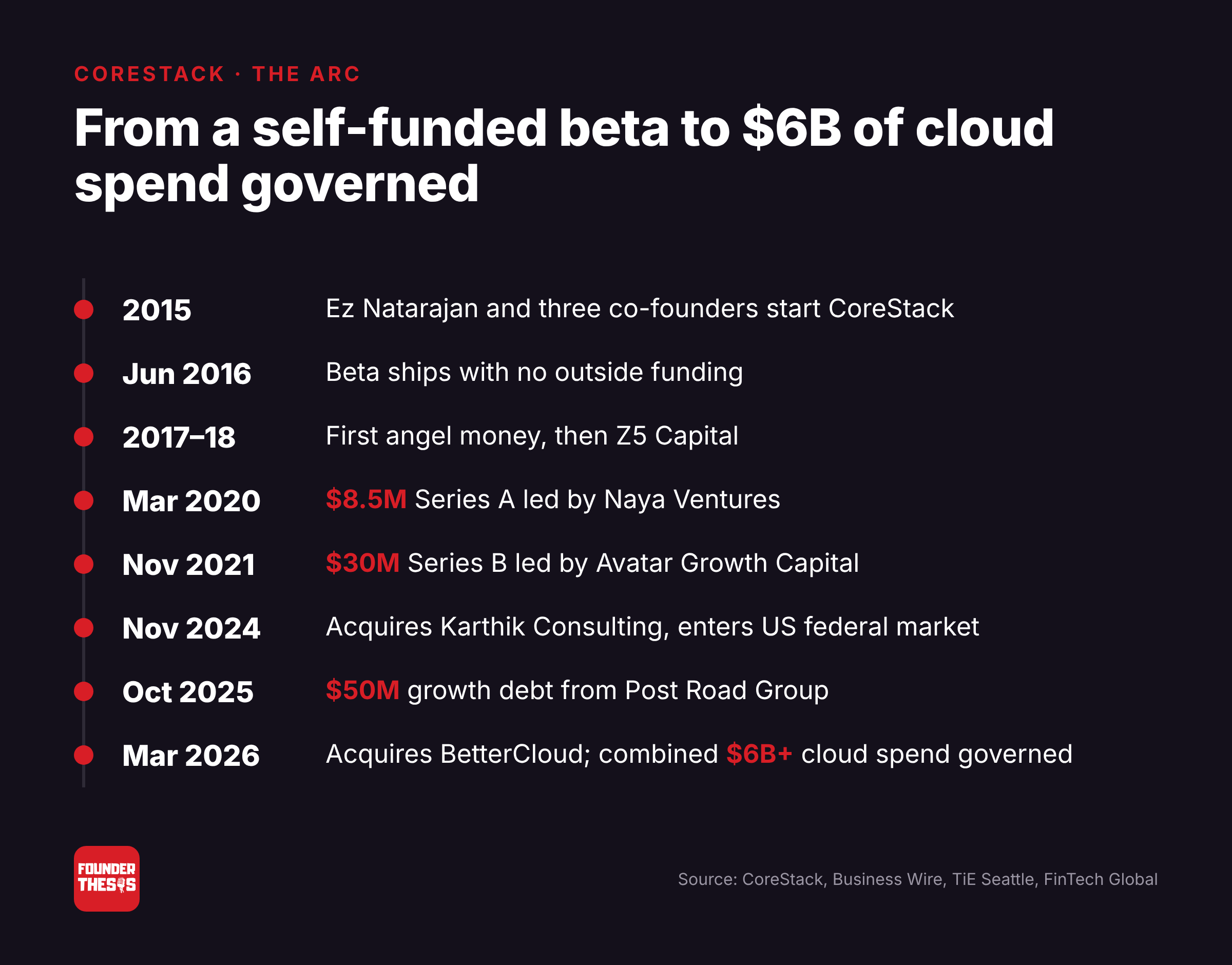
So the founders built it themselves. A beta shipped in June 2016, angels came in 2017 and Z5 Capital in 2018. Then:
March 2020: $8.5 million Series A led by Naya Ventures
December 2020: $4 million from Iron Pillar
November 2021: $30 million Series B led by Avatar Growth Capital, taking announced funding to $45 million
October 2025: $50 million in growth debt from Post Road Group
Natarajan puts total equity raised at about $85 million.
The lean years shaped who owns the company.
“So we have created, we have given more than 20% of the company to our employees itself.”
By his account, founders and leadership hold 30 to 40 percent and other employees about 20 percent. His personal net worth isn’t public. CoreStack posted 97% two-year revenue growth on Inc.’s 2026 Pacific list, and Natarajan says it is cash positive.
How is CoreStack governing AI and why did it buy BetterCloud?
CoreStack now applies the same idea to AI, in three layers. It tracks token spend and whether each answer was worth it. It controls which data models can reach, so someone impersonating an HR director can’t pull every employee’s records. And it checks agents’ actions, so one told to email a prospect named Tom Hanks doesn’t write to the actor.
In November 2024 CoreStack acquired Karthik Consulting, a US federal contractor with 125 staff. In March 2026 it announced the acquisition of BetterCloud, a SaaS management platform in the category India’s Zluri also competes in. Combined, they serve more than 2,000 customers and partners and govern over $6 billion in cloud consumption and $35 billion in SaaS spend.
Why won’t Ez Natarajan sell CoreStack to a hyperscaler?
Natarajan says selling to a cloud provider or AI lab would undermine the product. He compares governance to the separation of powers: a cloud provider or AI lab policing itself would be grading its own work.
“So you don’t want to get to the end of the world situation.”
His plan is to stay independent, take CoreStack public and build it to $1 billion in revenue. He once waited years for the world to believe in his problem. This time, he’s betting it catches up faster.
Listen now!
Other ways to listen:
Sources
CoreStack announces $8.5 million Series A led by Naya Ventures (Business Wire)
CoreStack closes $30 million Series B led by Avatar Growth Capital (Business Wire)
CoreStack raises $50m to boost AI-driven cloud governance (FinTech Global)
CoreStack enters federal market through acquisition (Washington Technology)
Inc. ranks CoreStack #65 on its 2026 Pacific list (Newswire)