

Utkarsh Kawatra’s myHQ does for office space what MakeMyTrip did for flights. It owns the buyer, and the scattered supply has to come to it.
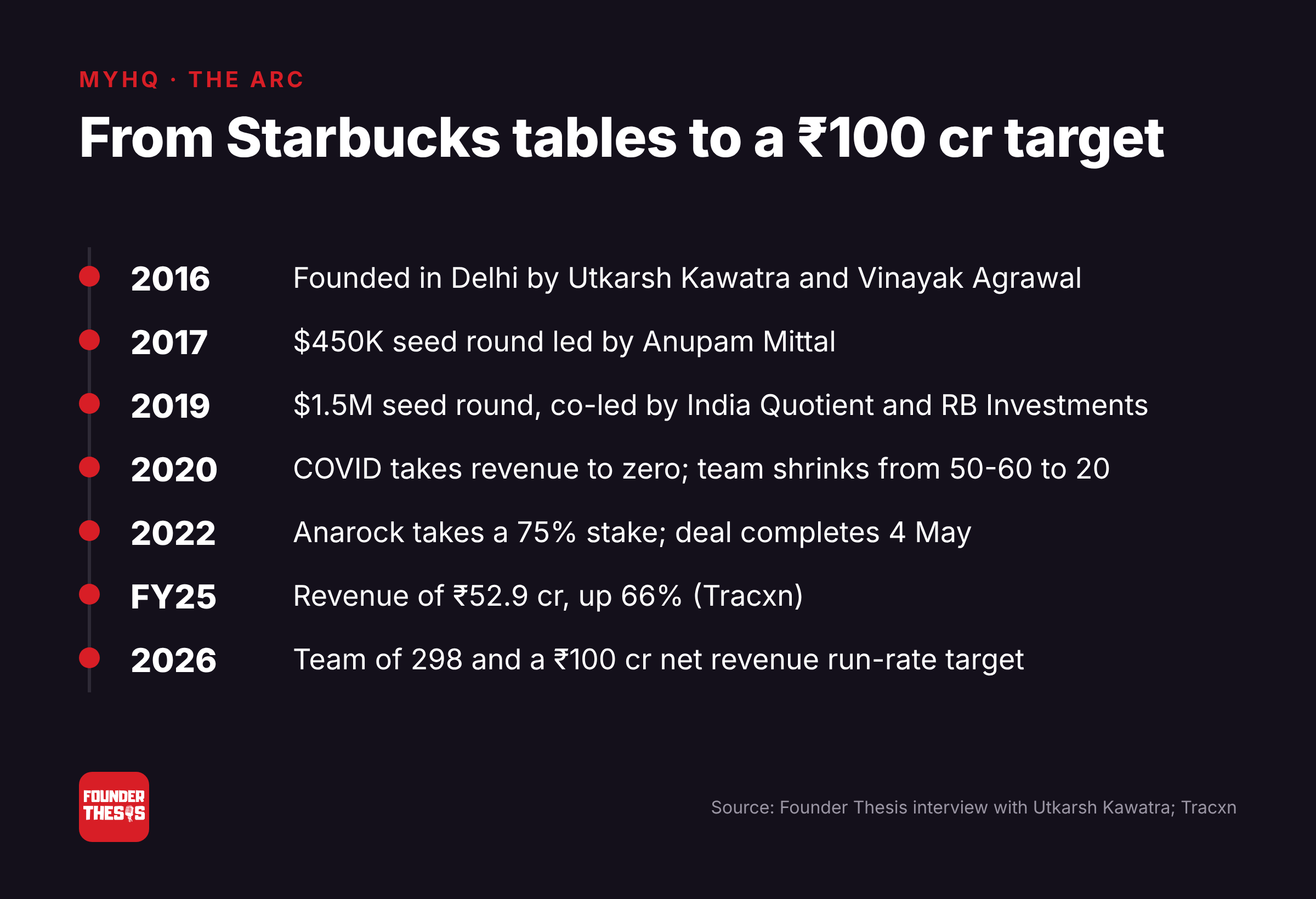
Utkarsh Kawatra is the co-founder and CEO of myHQ, a Delhi marketplace that finds flexible offices for companies. myHQ reported revenue of ₹52.9 crore in FY25, up 66% (Source: Tracxn), and Anarock took a 75% stake in 2022. Utkarsh told me the company is aiming for a net revenue run-rate of about ₹100 crore this year, and that he hasn’t raised money in two years.
Check out the video of the conversation here or read on for insights.
Utkarsh Kawatra’s path from Helion to myHQ
Utkarsh studied Mathematics and Computing at IIT Delhi and graduated in 2013. He worked at Opera Solutions, then joined Helion Venture Partners in 2014. In 2016 he started myHQ with Vinayak Agrawal, a classmate from IIT Delhi. He told me he planned to give it two or three years.
The idea came from a Starbucks table. Co-working was big in the US, and people in India were already working out of cafes. A friend’s lounge in Delhi became a daytime co-working space, and food and beverage outlets became the supply.
“Our biggest concern was whether the staff of that F&B outlet would switch on the Wi-Fi router at 10 in the morning.”
The customers were mostly freelancers, and a freelancer’s lifetime value is low. The money followed anyway. According to Tracxn, myHQ raised about $2.26 million across seven rounds. Outbox Ventures led an $83K seed in September 2016, and Anupam Mittal led a $450K round in November 2017. India Quotient and RB Investments co-led a $1.5 million seed in November 2019. Utkarsh also told me Ashneer Grover was among his investors.
How myHQ makes money
myHQ earns a commission when a company books a space, and it works like a consultant at the back end. The landlord or operator pays, and the commission on a flex lease is about one month’s rent.
Utkarsh walked me through the maths. A day pass bought at ₹250 and sold at ₹350 leaves ₹100 to ₹150. A 100-seater office at ₹8,000 a seat pays about ₹8 lakh from a single deal. That is roughly 8,000 day passes.
Utkarsh says 99.9% of myHQ’s transactions represent the client, and the platform shows clients its margin. His own line on the model:
“In principle, we believe real estate is a business where you should not be losing money per transaction.”
His estimate of myHQ’s net revenue mix, meaning the commission it keeps from each deal:
Flex leasing: about 40%
Virtual offices: 20-25%
On-demand bookings (day passes and meeting rooms): about 15%
MICE (meetings, incentives, conferences and events): 5-10%
Traditional leasing: about 10%
myHQ handles about 50,000 on-demand bookings a month in India. Think of what Housing.com and NoBroker did for homes, but for a 100-seat office where the commission is large enough to build a company on.
Why the flex office market is bigger than it looks
India’s flex office stock is above 100 million sq ft, according to myHQ’s Q4 FY26 flex operators report as covered by Allwork.Space on 15 June 2026. Utkarsh puts flex at 20-25% of new office leasing, growing 25-35% a year. IT and ITeS companies account for 40-50% of that demand, and banks and financial firms for about 15%. Global capability centres are arriving in smaller teams of 50 to 200 seats.
The listed operators show the size of the prize:
WeWork India: FY26 revenue of ₹2,440.1 crore, up 25.2%, and net profit of ₹74.9 crore (Inc42, May 2026)
Awfis: FY26 operating revenue of ₹1,493 crore, up 24%, and profit after tax of ₹71 crore (Inc42, 26 May 2026)
Smartworks: FY26 revenue of ₹1,796 crore, up 31% (Free Press Journal, Q4 FY26 results coverage)
Those three operators together earn roughly ₹5,700 crore. They also carry the leases. myHQ sits one step away from that risk, because the landlord pays its commission.
Utkarsh has a one-line theory of why this works:
“The person who owns the demand is generally the guy who’s calling the shots.”
He pointed to Airbnb, Uber and MakeMyTrip. Supply is fragmented, so whoever gathers the buyers sets the terms. It is the same demand-first logic that carried IndiaMART from the by-lanes of Delhi to an IPO.
COVID and the Anarock deal
In 2020 myHQ’s revenue went to zero and the team shrank from 50 or 60 people to 20. Utkarsh is candid about the judgment call that followed.
“There is a very thin line between being persistent and being stupid, and sometimes you cross it.”
In April 2022 Anarock, the property consultancy built by Anuj Puri, took a 75% stake. Tracxn records the announcement on 5 April 2022 and completion on 4 May 2022. Headlines at the time carried a figure of ₹125 crore. Utkarsh told me that number was a projected valuation, and that the deal itself was a rescue done at a low valuation, with revenue then around ₹1 to 2 crore.
He described the structure this way: Anarock invested, a new company bought the app and web assets along with 15 to 20 people, and the old cap table exited. WeWork India later became a primary shareholder, he says, and no single shareholder holds a majority today. Anarock’s stake means the two companies both compete and collaborate.
Utkarsh Kawatra and myHQ by the numbers
Here are the facts people search for most, in one place.
Founders: Utkarsh Kawatra (CEO) and Vinayak Agrawal, in 2016, Delhi
Funding: about $2.26 million in equity across seven rounds (Source: Tracxn)
Owner: Anarock took 75% in 2022; Utkarsh says WeWork India is also a primary shareholder and nobody holds a majority
Revenue: ₹52.9 crore in FY25, up 66%, with a net loss of ₹4.87 crore (Source: Tracxn)
Today: Utkarsh says myHQ is profitable, has grown 30 to 40 times since 2022, and employs over 300 people. Tracxn lists 298 employees
Target: a net revenue run-rate of about ₹100 crore this year, roughly ₹8 to 10 crore a month, with growth of 50-60% a year
Utkarsh calls it a lifestyle business for now, with an IPO as the long-term plan.
London, Dubai and the risks Utkarsh names
myHQ now operates in London and Dubai through myhqspaces.com. Utkarsh says opening a new city costs ₹3 to 5 crore. London has about 1,500 coworking spaces, and he claims its market is about the size of India’s flex market. Dubai is recovering its customer acquisition cost. London isn’t there yet.
At home he likes Hyderabad more than Bangalore. Mumbai’s BKC rents rose from ₹350 to ₹450 per sq ft in two years. Next on his list are commercial buying and selling, and possibly managed offices, where margins run 8-20%.
He also flagged two cautions for the whole sector. Under Ind AS 116, rent sits below EBITDA, so he expects buyers to move to profit-before-tax multiples. And the 9 to 10 year master leases signed by operators come up for renewal between 2028 and 2030, a cycle nobody has tested. He expects smaller operators with ₹50 to 200 crore of revenue to consolidate through M&A at low revenue multiples.
A category growing 25% a year, three large operators earning ₹5,700 crore, and a founder who takes a commission instead of carrying the lease: that is the riches-in-niches case for myHQ.
Listen now!
Other ways to listen:
Sources
Founder Thesis interview with Utkarsh Kawatra, recorded 18 August 2026
Tracxn, myHQ company profile, funding rounds and acquisition records (https://platform.tracxn.com/a/d/company/56812459e4b0e4fa316f4816)
Inc42, WeWork India FY26 results, May 2026
Inc42, Awfis FY26 results, 26 May 2026
Free Press Journal, Smartworks Q4 FY26 results coverage
Allwork.Space, report on India’s flex office market citing myHQ’s Q4 FY26 Indian Flex Office Operators Report, 15 June 2026
ET Realty, “Anarock buys 75% stake in myHQ for Rs 125 crore”
Founder Thesis research dossier on Utkarsh Kawatra